Sunday, 15 May 2011
Sunday, 8 May 2011
Saturday, 2 April 2011
My Time With Henri Cartier-Bresson

Written by the acclaimed Indian animation director, animator and photographer Ishu Patel - it tells the engaging story of when a young student Ishu met and worked alongside the 'master' - as he colloquially refers to him - for a short while in India, during the early 1960's.
It proves to be a fascinating read on many levels, not least because it allows a brief insight into this most reclusive of legendary photographers and some of his masterful work practices.
Ishu and 'Henri' went on to become firm friends, as you'll discover if you read the article, and I can only feel envious of Ishu's great fortune to meet and learn from the great Cartier-Bresson at first hand. To my mind it's akin to being taught to drive by Ayrton Senna, shown how to throw a punch by Muhammed Ali or taught how to kick a ball by Pele! In other words... a totally priceless experience!
I contacted Ishu to write him how much I enjoyed his recollections of 'Henri', and to tell him of the R3MAF HCB tribute page - and he has subsequently very kindly allowed me to reproduce his article in full on R3MAF.
You can read Ishu Patel's 'My Time With Henri Cartier-Bresson' by clicking on the above image or by going to:
www.r3maf.com/Ishu_Patel_HCB.html
MAF
Thursday, 24 March 2011
Monday, 21 March 2011
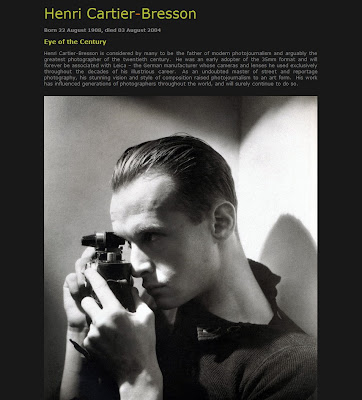
NEW: Henri Cartier-Bresson Tribute Page now includes comprehensive biography.

R3MAF has had a Henri Cartier-Bresson tribute page since 2004 ...the year in which the great man, myself and many believe to be the greatest photographer of the twentieth century, sadly passed away.
Up and until very recently the aforementioned tribute page simply comprised of a famous HCB quotation, with the dates of his life presented against the background of an animated screen of several famous Cartier-Bresson images.
As of now, the new tribute page consists of a comprehensive text and pictorial biography with a small gallery of some essential HCB images included. Please click on the above image or go to... www.r3maf.com/HCB.html to view.
Permission to display HCB images has been sought, and kindly given from both the Fondation Henri Cartier-Bresson and Magnum Photos.
Wednesday, 2 March 2011
George Underwood ...an ethereal imagination
Visitors to R3MAF who may have clicked upon the Links Page over recent years will have noted that the links on display have been typically listed under three subcategories i.e. Camera Manufacturers, Camera Accessories, and the equally enigmatically titled... Other Websites.
It's unusual to receive feedback for simply providing a link to another website, but many have taken the time and effort to drop a line or two thanking R3MAF for bringing the GU website to their attention. More gratifying is the fact that they also feel compelled to wax lyrical about the stunning content on George’s website - care of his very impressive galleries of superb illustrations and beguiling oil paintings.
Once viewed it's not difficult to see why George Underwood is one of my favourite British artists, and as the creator of literally dozens of book covers and iconic music album covers (see below for just a few examples) I would venture that many readers of this blog are already admirers of George’s considerable artistic talents and perhaps not know it.
GEORGE UNDERWOOD ~ ALBUM COVERS
However it’s George's ethereal and otherworldly figurative oil paintings that really stand out for me as being at the vanguard of his always unique and compelling work ...and in my opinion it would appear that Mr Underwood is simply getting better and better with the passing of the years.
To that end, I’ve taken the opportunity to display just a small sample of my favourite, more recent, George Underwood paintings below. You can also view an R3MAF slideshow featuring the aforementioned paintings and more at:
www.r3maf.com/georgeunderwood.html
As you'll see in the small collection of paintings below, there’s a degree of detail in the minutiae of his brush work and an impeccable use of colour which also co-exists with often surreal wonderful play of light, that to my eye is reminiscent of the finer portrait painters of previous centuries. Many international exhibitions, and prestigious invites to show at institutions such as the illustrious Royal Academy and The Royal Society of British Artists would seem to bear testament to that opinion too.
Please click on the below link to read George Underwood's biography:
www.georgeunderwood.com/pages/george-underwoods-biography/3857
Regards
Mark Franklin
RedheadBig In Japan
Girl With Triangular Earring
Obviously Six Believers
Return of the Soulful Warrior
The Appearance
Striped Sleeves
Be Somebody
Embroidered Hat
Eye Shadows
Knole Portrait
Leah
The Reveal
Rainy Day Women
Silver and Gold
Postscript:
As a young student the author studied History of Art specialising in the Italian Renaissance period from Giotto to the Big Three i.e. Da Vinci, Michelangelo and Raphael. His passion for architecture, painting and sculpture of all periods, schools, and movement has continued unabated ever since - and over the years he has been fortunate to visit some of the world’s finest art galleries and museums. Sadly he cannot paint to save his life ...unless it involves a tin of Dulux and a paint roller!
Please note:
All of the above images have been reproduced with the kind permission of the artist - and all work is protected by copyright.
Thursday, 24 February 2011
Sunday, 20 February 2011
Sunday, 13 February 2011
New Favourite Images Page Added
Monday, 31 January 2011
Senna Film Wins Major Film Award
The new movie made about the greatest racing driver of all time... the legendary Ayrton Senna, has just won a prestigious award at the famous Sundance Film Festival.
The film, which was released in Japan and Brazil late last year and is being screened throughout the rest of the world in 2011, was awarded the World Cinema Audience Award for Documentary Film.
The Senna film is due for release in the United Kingdom in June this year - deliberately coinciding with the build-up to the British Grand Prix. It has already received rave reviews and achieved huge commercial success in the countries where it has been shown ...and the Sundance Award will no doubt be a huge boost to its chances of being a hit in the massive American market too.
Ayrton Senna 1960 - 1994
Sunday, 14 November 2010
Sebastien Vettel - 2010 Formula 1 World Champion

Many congratulations to Sebastian Vettel for becoming the new Formula 1 World Drivers' Champion by winning the final Grand Prix in Abu Dhabi in such suberb style this afternoon! I hope this'll be the first of many WDC's for the driver many regard as the best of his generation.
Sebastian's official website is:
Thursday, 26 August 2010
Thursday, 19 August 2010
Nikon launches new cream machine!
19 August 2010:
Nikon has announced the launch of its much anticipated new 85mm F/1.4 lens ...the AF-S Nikkor 85mm f/1.4G.
This lens supersedes the highly acclaimed AF Nikkor 85mm f/1.4D IF known affectionately among Nikon users as the ‘cream machine’. The latest reincarnation of this legendary lens has a totally new optical design, Silent Wave Motor (SWM) ...and Nano Crystal Coat. UK RRP: £1499.99
AF-S NIKKOR 85mm f/1.4G Main Features:
• Fast, high-performance mid-telephoto 85mm fixed focal length lens with a maximum aperture of f/1.4
• New optical design that makes the most of the performance expected of the latest fast fixed focal length NIKKOR lens
• Nano Crystal Coat adopted to significantly reduce ghost and flare. Please click on the following link for more information concerning NCC http://imaging.nikon.com/products/imaging/technology/scene/20/index.htm
• Equipped with a Silent Wave Motor (SWM) for extremely quiet autofocusing
• Equipped with two focus modes, M/A and M, featuring a new and improved manual focus drive mechanism that reduces manual focus time lag for improved manual focus operation in M/A mode.
• Nikon's internal focusing (IF) system has been adopted with no increase in the length of the lens
Specifications:
Focal length: 85mm
Maximum aperture: f/1.4
Minimum aperture: f/16
Lens construction: 10 elements in 9 groups (with Nano Crystal Coat)
Angle of view: 28°30’ (18°50’ with Nikon DX format)
Minimum focus distance: 0.85 m/2.79 ft.
Maximum reproduction ratio: 0.12x
No. of diaphragm blades: 9 (rounded)
Filter-attachment size: 77mm
Diameter x length:
(extension from lens mount) Approximately 86.5 x 84 mm/3.4 x 3.3 in.
Weight approximately: 595 g/21.0 oz.
Supplied accessories: 7mm Snap-on Front Lens Cap LC-77, Rear Lens Cap LF-1, Bayonet Hood HB-55, Flexible Lens Pouch CL-1118
Brief Glossary:
G-type NIKKOR
The G-type NIKKOR has no aperture ring; aperture should be selected from camera body.
Nano Crystal Coat
Nano Crystal Coat is an anti-reflective coating that originated in the development of NSR-series (Nikon Step and Repeat) semiconductor manufacturing devices. It virtually eliminates internal lens element reflections across a wide range of wavelengths, and is particularly effective in reducing ghost and flare peculiar to ultra-wideangle lenses. Nano Crystal Coat employs multiple layers of Nikon’s outstanding extra-low refractive index coating, which features ultra-fine crystallized particles of nano size (one nanometer equals one millionth of a mm). Nikon now proudly marks a world first by applying this coating technology to a wide range of lenses for use in consumer optical products.
Silent Wave Motor
Nikon's AF-S technology is yet another reason professional photographers like NIKKOR telephoto lenses. AF-S NIKKOR lenses feature Nikon’s SWM which converts “traveling waves” into rotational energy to focus the optics. This enables high-speed autofocusing that’s extremely accurate and super quiet.
Internal Focusing (IF)
Imagine being able to focus a lens without it changing in size. Nikon's IF technology enables just that. All internal optical movement is limited to the interior of the nonextending lens barrel. This allows for a more compact, lightweight construction as well as a closer focusing distance. In addition, a smaller and lighter focusing lens group is employed to ensure faster focusing. The IF system is featured in most NIKKOR telephoto and selected NIKKOR zoom lenses.
Sunday, 18 July 2010
Mark Antony Franklin to be included in... Who's Who in Visual Art - 100 Fine Art Photographers.


http://www.whoisverlag.de/index-en.html#AnkerPhilosophieEN
http://www.whoisverlag.de/index-en.html
Thursday, 11 March 2010
PENTAX Announces First Medium-Format Digital SLR Camera
March 2010: HOYA CORPORATION PENTAX Imaging Systems Division is pleased to announce the launch of the PENTAX 645D lens-interchangeable, medium-format digital SLR camera. Thanks to the incorporation of a large image sensor, equal in performance to professional-standard digital camera backs, this high-performance model delivers super-high-resolution images with approximately 40 effective megapixels. It also offers outstanding dependability and superb operability and manoeuvrability to make outdoor shooting effortless and comfortable for demanding photographers.The PENTAX 645D has been developed to provide super-high-resolution images produced by large image sensors — something previously available only on professional models — to serious landscape and outdoor photographers. It combines exceptional image quality with excellent manoeuvrability and outstanding reliability to simplify professional-level outdoor shooting. Thanks to the incorporation of a large, high-performance image sensor (measuring 44mm by 33mm) and PENTAXoriginal image-processing technology, it produces extra-sharp, super-high-resolution images with approximately 40 effective megapixels. It features remarkable durability and dependability, thanks to its lightweight but solidly built body featuring a magnesium-steel-alloy frame, reinforced glass LCD panel protectors and a reliable dustproof, weather-resistant construction. In addition, it is designed to be compatible with the majority of the existing PENTAX 645 system, so that current PENTAX 645-series camera users can take advantage of their valuable assets, including high-performance SMC PENTAX 645 interchangeable lenses.
Thursday, 19 November 2009
Zeiss launch new ZF.2 lenses with CPUs for Nikon

Wednesday, 14 October 2009
Nikon announce D3S Digital SLR Camera Body

Nikon has announced the launch of the FX-format D3S D-SLR ...providing professional photographers with a powerful tool that redefines the boundaries of digital SLR versatility, while maintaining the strength of superior image quality and high speed performance inherited from the groundbreaking D3.
The D3S enables not only new opportunities in low-light photography, but also provides photographers with added shutterspeed and aperture freedom with a base ISO sensitivity range from ISO 200 to a remarkable 12,800.
Additionally, expanded ISO equivalent settings up to a staggering 102,400 are available, enabling photographers to create images previously thought impossible. The Nikon D3S builds upon the success of the Nikon D3, the professional digital SLR that set new standards for D-SLR performance ...and utilizes a newly designed Nikon original 12.1-megapixel FX-format CMOS sensor that also integrates its amazing low-light ability to High Definition (HD) video, creating a uniquely capable multi-media tool to meet the needs of a changing imaging landscape.
Feature Highlights:
ISO performance: ISO 12800 as standard, expandable to ISO equivalent of 102400 (Hi 3).
Large pixel pitch: The D3S’s image sensor has been completely redesigned from the D3 - the inner structure has been further optimised, with the pixel count and large pixel pitch maintained for even greater latitude in high ISO performance. The D3S promises to capture and render light in ways that no other ordinary digital SLR cameras has yet achieved, with a significantly higher signal-to-noise ratio and a wide dynamic range for unmatched image quality for both still images and movies throughout the broadened ISO sensitivity capabilities.
New and improved D-Movie function: From well-lit scenes to extremely low-lit situations, the D3S’s D-Movie mode delivers unique versatility. The newly refined D-Movie offers HD quality (1,280 x 720 pixels) Motion-JPEG movies at 24 fps. By controlling the aperture from the widest f-stop to the smallest, the large FX-format sensor renders low-noise images with beautiful bokeh effects from a large selection of NIKKOR lenses. High-Sensitivity Movie mode allows users to shoot at up to ISO equivalent of 102,400in places too dark to see clearly with their own eyes. D-Movie footage is easy to trim in-camera by simply selecting the starting and ending point. An extra bonus for sports and news photographers is the ability to save selected movie frames as JPEGs for immediate printand web publishing needs. The D3S has both an internal mono-aural microphone and an external stereo microphone input, enabling higher fidelity audio recording.
Image sensor cleaning: Another significant improvement from the D3 is the employment of the Image Sensor Cleaning function, which generates vibrations at four specific frequencies to optimise dust removal. This function can be set to operate automatically when the camera is turned on and off, or manually.
EXPEED: Nikon’s fast, comprehensive, and energy-efficient approach to in-camera image processing maintains the rich initial data’s integrity through 14-bit A/D conversion and 16-bit image-processing, which demonstrates the enormous creative potential of NEF (Nikon Electronic Image Format). Combined with Nikon’s FX-format sensor, the D3S produces an exceptional tonal range and minimized tone jumps. Users can expect more accuracy with difficult colour combinations such as skin tones and strong reds in the same frame without over-saturation and finer tonal gradation in highlights, even with extremely bright subject matter.
Lateral chromatic aberration reduction: The D3S corrects colour fringes caused by chromatic aberrations that, in some instances, can appear at the edges of differing subject elements. Lateral chromatic aberrations are corrected regardless of lens type — whether telephoto, wide-angle, non-CPU and other types of NIKKOR lenses.
Active D-Lighting: Nikon’s Active D-Lighting automatically regulates the dynamic range of high-contrast scenes, pulling out shadow details and preserving highlights while maintaining proper contrast. The D3S allows photographers to choose from six Active D-Lighting settings, including the newly added Auto and Extra High, as well as High, Normal, Low and Off. You can also bracket Active D-Lighting strength levels up to five frames and select the best rendition afterwards.
Picture Control: Helps you define the look and feel of your images by custom-tailoring sharpness, saturation and other parameters to match your creative intentions. The D3S comes with four pre-installed Picture Control profiles, which can be fine-tuned and saved as new custom Picture Control profiles that match your personal shooting style or particular shooting conditions. These profiles can easily be copied to additional cameras.
Speed and readiness throughout the workflow: The D3S optimises workflow speed and fluidity throughout the entire shooting process. Start-up time is approx. 0.12 seconds* and release time lag is minimised to approx. 0.04 seconds*, exactly as fast as the D3, but the D3S’s increased buffer memory is twice as large as that of the D3’s. In addition, the D3S’s autofocusing, image processing, memory card access and recording, USB interface and optional wireless transmitter all work together to keep professional photographers focused. And for sport and news photographers, many of the D3S’s JPEG files are print-ready with little or no post-production: an extra edge when time is short.
9-frames-per-second* shooting rate in FX-format, 11 fps* in DX crop: the D3S’s powerful stepping motor allows for a more steady delivery of fast continuous shooting speeds at a wider range of aperture settings than lesser cameras can claim. Professionals will now have greater control and fewer limitations when making the images they desire. With the DX crop, photographers can also add a 1.5x picture angle and a faster frame rate to their arsenal. Furthermore, the factory-installed buffer memory is twice the capacity of the D3, dramatically increasing the power of continuous shooting.
Scene Recognition System: Nikon’s exclusive 1,005-pixel RGB sensor precisely reads brightness and colour information to raise the overall accuracy of AF, AE, i-TTL flash control and auto white balance to new heights, thanks to the Scene Recognition System. The D3S’s AF delivers superb subject tracking and subject identification performance. Highlight analysis used for AE reproduces brightness faithful to the eye, and light source identification makes auto white balance uniquely precise and reliable.
51-point AF: The D3S’s strategically positioned 51 AF points deliver faster focus, even with quick and/or erratic subject movement. The 15 cross-type sensors in the centre of the frame maintain the same outstanding performance with any AF NIKKOR lens f/5.6 or faster. There are four Dynamic-area AF options, including 51 points (3D-tracking), which accurately follows your subject by shifting focus points using colour and brightness information from the Scene Recognition System. This gives users an extra advantage when composition is important but your subject’s movement is extremely erratic. Single-point and Auto-area AF modes are also available.
Sophisticated AE with highlight analysis: Nikon’s exclusive 3D colour matrix metering II is highly praised for its outstanding performance and faithful exposure results — even in complex, unforgiving lighting conditions. The D3S takes accurate exposure further, using highlight analysis from the Scene Recognition System and then carefully selecting from a database containing information from over 30,000 actual shooting situations.
Informed auto white balance: Nikon’s auto white balance is often noted for its accuracy, achieving remarkable results, even in challenging conditions with mixed light sources ...with the D3S, auto white balance makes even further progress. Professionals can expect white as truly white in a wider variety of settings.
Approx. 100% frame coverage: The D3S’s large prism gives you the FX-format visual advantage when you shoot. The viewfinder image is not only larger and brighter, but the focusing screen is also carefully designed to help you to more intuitively sense sharp focus, be it manual or autofocus.
Superior durability: For the reliability professionals demand, the shutter of the D3S has been tested for up to 300,000 cycles in fully assembled cameras under rigorous conditions. The ruggedly constructed D3S employs a strong yet lightweight magnesium alloy for its body, exterior cover, chassis and mirror box. Furthermore, a comprehensive series of O-rings and other specialised seals, combined with additional Nikon engineering, protect the D3S against invasive moisture, dust and even electromagnetic interference.
Twin CF card slots: The D3S lets you designate each card slot for certain tasks: record two full CF cards of data sequentially for a large amount of storage, record the same data onto two cards (backup), record RAW and JPEG simultaneously onto separate cards, and transfer data from one card to another. You can also designate the slot for data-heavy D-Movie recording.
Long-life battery: The D3S uses the EN-EL4a rechargeable batteries. Power consumption and power management systems have been engineered for greater operating efficiency, so you can expect long battery life, shooting up to 4,200 images* per charge.
Easy-to-access Live View mode: The dedicated Live View button gives you instant access to two Live View modes: Tripod mode for accurate AF operation and Hand-held mode for more versatile shooting angles. The speed for Contrast-detect AF in Tripod mode has also been improved for enhanced practicality.
Quiet Shutter-release mode for non-intrusive shooting: Photographers can select “Q” on the release mode dial to substantially reduce the sound of the camera’s mirror-down during shooting. This is particularly useful when shooting in restrictive conditions such as when photographing theatrical performances or wildlife.
3-in., approx. 921k-dot color, 170ยบ viewing angle LCD monitor: The D3S’s large, high-resolution LCD monitor delivers bright, crisp image playback with up to 27x enlargement for immediate and precise image confirmation. Each LCD is covered with scratch resistant tempered glass and individuallycalibrated and fine-tuned at the factory to deliver consistent performance.
Tuesday, 6 October 2009
The Nobel Prize in Physics 2009
Half of the 10 million Swedish crowns prize money goes to Charles K. Kao, whose work in the mid-60s enabling light to travel long distances through glass strands made the fiber optic cables we have today possible.
The second half of the prize is divided between Canadian Willard S. Boyle and American George E. Smith, who both worked at Bell Labs in Murray Hill, New Jersey, and invented the so-called charge-coupled device semiconductor, better known to anyone that has ever looked at a digital camera spec list as a CCD.
In 1969 Boyle and Smith invented the first successful imaging technology using a digital sensor, a CCD (charge-coupled device).
The two researchers came up with the idea in just an hour of brainstorming, according to Boyle, who spoke during a press conference today. "It is amazing that a [CCD device] was created so quickly," said Joseph Nordgren, the chair of the Nobel Prize committee.
Often considered as the digital camera's electronic eye, CCD technology has revolutionized how images are collected from spacecraft, by telescopes, and in medical imaging ...effectively replacing the film camera in every aspect of photography.
The Nobel Prize committee concluded that the three scientists have helped shape the foundations of today’s networked society. ‘They have created many practical innovations for everyday life and provided new tools for scientific exploration,’ the committee said in a statement.